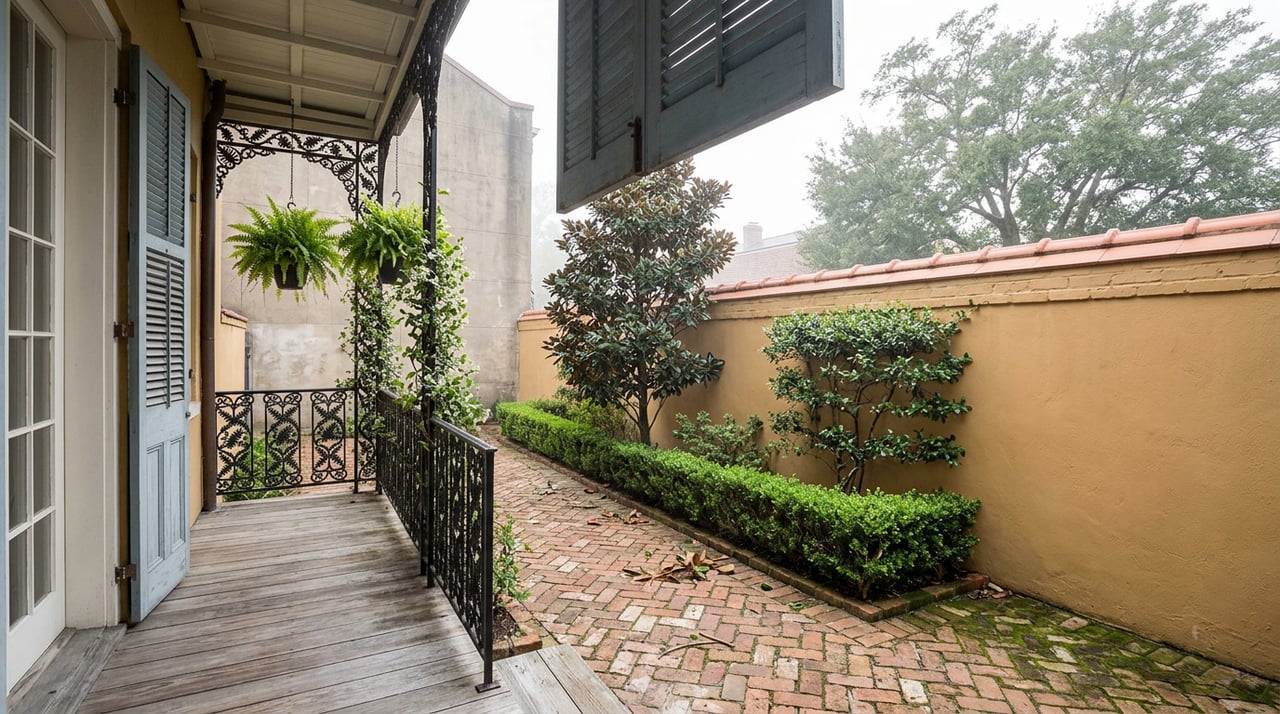
The Marigny and Bywater Median Hides a Lottery You Don't See on the Listing
September 24, 2026
September 24, 2026
Two shotgun doubles sit on the same block in the Marigny Triangle. Same century of construction, same twelve-foot ceilings, same distance to Frenchmen Street. A buyer touring both last spring assumed the price gap between them came down to a renovated kitchen or a newer roof. It didn't. One property came with an active short-term rental permit attached to the address. The other didn't, and under the city's current rules, it never can, not unless that specific square block opens back up in a future lottery.
That gap is the part no median price captures. If you've already looked at Marigny or Bywater on a portal and clocked the number, the number is real, but it's an average of two different housing markets sitting on the same streets. One market is made up of homes that can legally generate short-term rental income. The other is made up of homes that, for reasons having nothing to do with condition or charm, cannot. Understanding which market a specific listing belongs to matters more than the neighborhood-wide figure ever will.
Pull up three different sources for the same six or seven blocks and you'll get three different stories. As of March 2026, Homes.com listed the Marigny median sale price across all home types at $418,000 for the trailing twelve months, up 6 percent year over year, while its single-family figure for the same period sat at $459,000 with an average sale price of $485,897. Homes typically spent 105 days on the market, against a 55-day national average. Two months later, in May 2026, Redfin had the Marigny median sale price across all home types at $491,335, up 12.7 percent year over year. Also in May 2026, Movoto showed Bywater single-family homes listing at a median $462,000, down slightly month over month, with price per square foot at $280, down 7 percent from a year earlier.
| Source | Area / Home Type | Figure | Window |
|---|---|---|---|
| Homes.com | Marigny, all home types | $418,000 median (+6% YoY) | Trailing 12 months, as of March 2026 |
| Homes.com | Marigny, single-family | $459,000 median | March 2026 |
| Redfin | Marigny, all home types | $491,335 median (+12.7% YoY) | May 2026 |
| Movoto | Bywater, single-family | $462,000 median list price | May 2026 |
Part of that spread is ordinary portal noise: different boundary lines, different mixes of condos versus cottages, list price versus sale price. But a meaningful piece of it comes from something no portal disaggregates. Within those same handful of blocks, a subset of properties carries a legal right to operate as a short-term rental and a subset doesn't, and that right is capped, rationed, and increasingly hard to acquire. Blend those two populations into one median and you get a number that describes neither market well.
New Orleans runs STRs through two separate permit tracks. A Commercial permit, or CSTR, applies to non-owner-occupied properties in commercial or mixed-use zones. A Non-Commercial permit, or NSTR, applies to owner-occupied homes and requires the owner to hold a Louisiana homestead exemption on that address. The city stopped accepting new CSTR applications in June 2023, and that freeze has held ever since. Anyone hoping to buy their way into commercial-scale short-term rental income in New Orleans today is shopping for a property that already holds a grandfathered CSTR license, a supply that only shrinks.
The residential track has its own bottleneck. NSTR permits are capped at one per city square and awarded through a quarterly lottery. If a square already has an active license, no exception process opens the door. Applicants must own the home, live in it, and hold the homestead exemption there, which rules out absentee investors entirely on this track. The ordinance also carves out distinct treatment for specific pockets, including a named RIV-4 Marigny Sub-District, layered on top of the citywide caps. Even within Marigny itself, the rules aren't uniform block to block.
That scarcity shows up in enforcement, too. As of February 2025, the city had issued roughly 2,500 STR licenses total, about 1,350 of them residential, a figure that stood against an earlier 2023 estimate of around 1,260 permits in circulation while platforms carried roughly 5,710 active listings. The gap between licensed and listed points to a meaningful stretch of unpermitted operations, and since June 2025, Airbnb and Vrbo have been required to verify a city-issued permit before a listing can even take a booking, which has started closing that gap from the platform side.
None of this arrived quietly. In 2022, the Fifth Circuit struck down New Orleans's earlier rule tying STR permits to a homestead exemption, ruling it discriminated against out-of-state owners. The city rewrote its ordinances in 2023, codified as 029381 and 029382 MCS effective July 1, and was sued again almost immediately. A federal temporary restraining order froze applications from September 2023 into early 2024 while a district judge reviewed the new framework. Council member JP Morrell described that ruling at the time as upholding "the vast majority of these rules," while noting the judge required the city to let usufruct and trust holders back into the lottery pool.
The bigger test came later. On September 8, 2025, a federal district court delivered what one law firm's write-up called a decisive win for the city in Bodin v. City of New Orleans, dismissing nearly every challenge to the current framework and leaving the one-per-square lottery intact. The following month, the Fifth Circuit narrowed things again on appeal, striking down the city's ban on LLCs and corporations holding STR permits as lacking a rational basis, while leaving the density cap, the zoning restrictions, and the owner-occupancy requirement standing. Corporate ownership structures are viable again. The scarcity that drives value isn't going anywhere.
The legal questions aren't fully closed. A separate case working through the Fifth Circuit as of December 2025 involves a property owner arguing the city couldn't wipe out a decades-old rental use overnight without some process, an argument at least one appellate judge seemed to take seriously during oral argument. Whatever comes of that case, it's a reminder that this is a live regulatory environment, not a settled one, and a buyer evaluating a listing today should treat any permit status as current as of the closing date, not a fact fixed in stone.
If you're weighing Marigny or Bywater against another close-in neighborhood, the median price is a reasonable starting point and a poor finishing point. The more useful question for any specific address is whether that property's square already has an NSTR permit attached, whether a listing claims a grandfathered CSTR license, and whether that claim can be verified through the city's Short Term Rental Administration rather than taken on faith from a listing description. A property advertised as a legal short-term rental that turns out to be operating without a current permit isn't a bargain. It's a liability that transfers with the deed.
For a buyer planning to live in the home and simply wanting the option to rent a room or the whole property occasionally, the owner-occupancy and homestead requirements actually work in your favor, since that's the only permit type available to you regardless of budget. For an investor hoping to buy income property at scale, the calculus is different: the CSTR moratorium means your realistic options are limited to existing licensed properties, and that shrinking, non-renewable supply is exactly why those addresses can command a premium the neighborhood median won't show you.
Either way, the number on the portal was never going to tell you which market you were actually shopping in. That's a conversation worth having before you write an offer, not after.
If you're comparing Marigny and Bywater against other New Orleans neighborhoods, our Marigny/Bywater neighborhood guide is a good next stop, and our team can walk through the permit status of a specific address before you get attached to a number that might not tell the whole story. Burk Brokerage Real Estate offers a free home valuation that accounts for exactly this kind of detail. Reach out when you're ready to look past the median.
Stay up to date on the latest real estate trends.


The oldest continuously operating street railway in the world does not run in Paris or London. It rattles down a live oak lined avenue in New Orleans, and it has been … Read more
We pride ourselves in providing personalized solutions that bring our clients closer to their dream properties and enhance their long-term wealth. Contact us today to discuss all your real estate needs!
BURK BROKERAGE REAL ESTATE
6260 VICKSBURG ST STE A NEW ORLEANS, LA 70124